General, quoting & support.
Add: Building E, No.58, Nanchang Road, Xixiang , Baoan District Shenzhen City, Guangdong, China
Tel : 0755-27348887
Fax : 0755-27349876
E-mail : svc@pcbastore.com

Flexible PCB Manufacturing Process: How to Fabricate
PCBA Store / 2025-12-03
Contents [hide]
Introduction to Flexible PCBs
Flexible PCBs, commonly called FPCs, are built on very thin polyimide (PI) or polyester (PET) base materials. These bases let the board bend and fold easily while still working perfectly. People make them in single-sided, double-sided, or many-layer types. They usually come in yellow, black, white, or clear colors. The boards stay super light and extremely thin—most are less than 0.25mm thick. This makes them perfect for tight spaces. They can cut assembly weight by as much as 70% when compared with regular rigid boards.
Making FPCs needs careful work to keep signals strong and the board tough. Factories use modern tools to create very narrow lines down to 50µm and tiny holes as small as 75µm. The main advantages are better heat control, strong resistance to shaking, and easy fitting into 3D shapes.
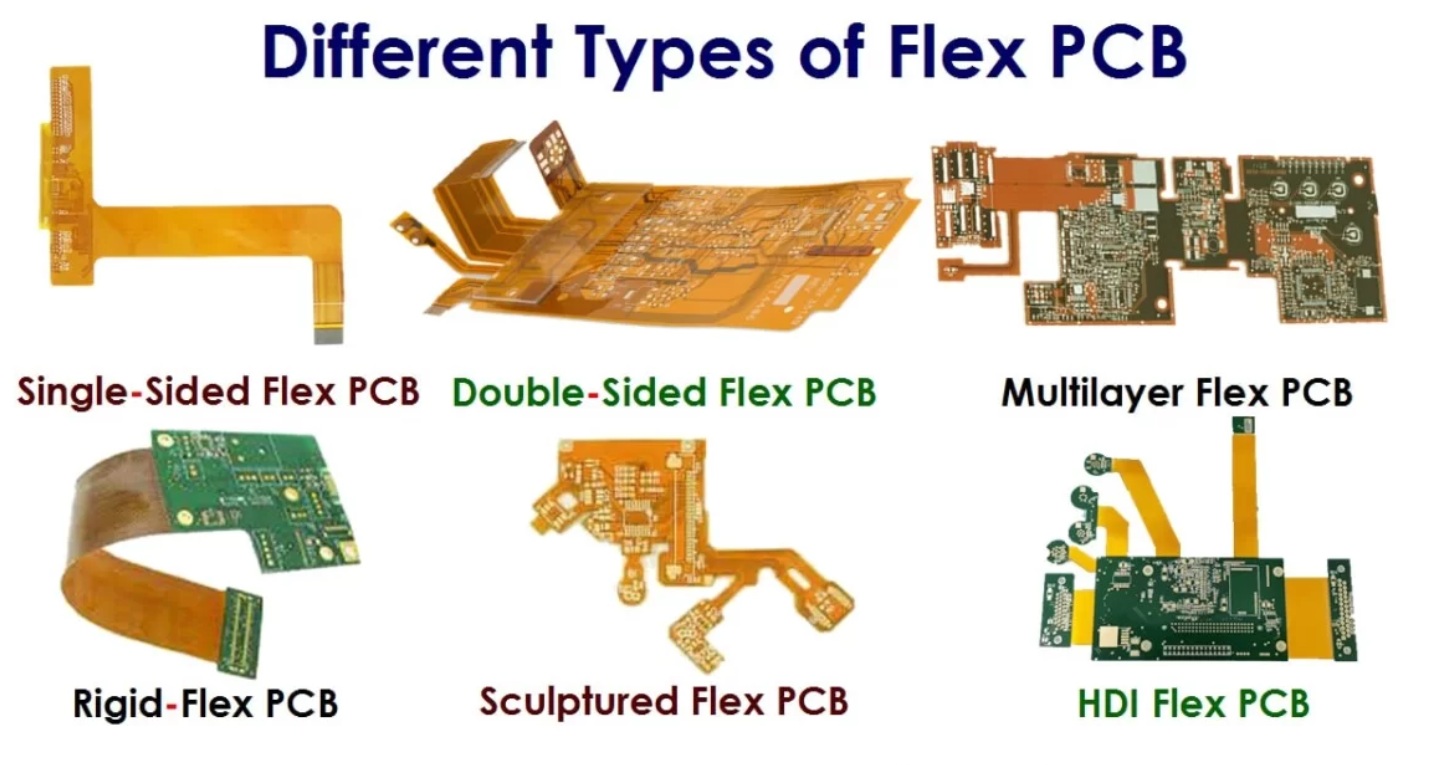
img.Different types of Flexible PCB.jpg
Detailed Manufacturing Steps
Step 1. Fabricating Flexible PCB Laminates
Everything starts with special laminates. Workers pick rolled or electrolytic copper foil, PI films, and sticky adhesives that match strict rules. Copper foil gets pressed to 12µm, 18µm, 35µm, or 70µm thick. PI films vary from 12.5µm to 75µm, and adhesives stay around 20µm thick.
During lamination, people brush adhesive onto PI film. Then they join it tightly with copper using high heat and strong pressure. This creates the coverlay. Coverlay works like solder mask but stays flexible. It covers and guards the circuits. The adhesive bond stays stronger than 1.5 kg/cm. That strength matters a lot for boards that bend many times. Workers check everything carefully at this stage. They look for even layers so nothing peels apart later. These boards can handle up to 100,000 bending cycles.
Step 2. Cut Laminates for FPC Fabrication
After the laminates are ready, workers cut them into easy-to-use panels. Fast slitting machines carefully slice the big rolls. Typical panel size is 18x24 inches. This way, very little material goes to waste. Edges line up within ±0.1mm. Workers also add small fiducial marks. Machines use these marks later for perfect placement.
For multilayer FPCs, cutting becomes more detailed. Rigid-flex types mix FR-4 stiff parts with soft PI areas. PCBA Store can build up to 6-layer FPCs. They offer symmetric or asymmetric layouts. Total thickness can go as low as 0.11mm for prototype boards.
Step 3. Drilling
Drilling makes plated through-holes (PTHs) so layers connect properly. Laser drilling works best for thin flexible material. It creates tiny holes starting at 0.1mm with ±0.05mm accuracy. Holes can sit as close as 0.3mm apart. That helps with high-density designs.
Mechanical drills open the coverlay in oval shapes. This costs less. Punching tools make perfect square or rectangle holes. Blind vias keep aspect ratios near 1:1. That keeps plating safe and strong. After drilling, plasma cleaning removes all dust. Clean hole walls help plating stick well.
Step 4. VCP Electroplating
Vertical continuous plating (VCP) puts copper inside the holes. It builds even walls 15-25µm thick. The line runs step by step: activation, thin copper layer, then full plating in acid baths. Rinsing happens after each tank. The moving conveyor keeps everything the same. This lowers empty spots and raises conductivity.
For flexible boards, plating must stay soft enough to bend later without cracking. PCBA Store uses VCP lines that follow IPC-6013 rules. They handle heavy copper up to 3oz in rigid-flex power sections.
Step 5. Circuit Transfer (Exposure)
Workers first cover copper with light-sensitive dry film. Then they place a phototool mask on top. Strong UV light shines through for a short time. The pattern hardens the film where circuits should stay. Unwanted areas remain soft and wash away later.
Light strength stays between 10-20 mJ/cm². Exposure lasts 30-60 seconds. These settings give clear lines down to 65µm wide. Alignment stays within ±25µm. That keeps multilayer boards perfectly matched.
Step 6. Etching
Etching eats away extra copper with sodium hydroxide (NaOH) solution. Spray chambers work in several stages. Metal disappears at 20-30µm per minute. Only the protected circuit stays behind. After that, a different chemical removes the hardened film. Clean traces and pads appear.
Factories reach 75µm width and 75µm space easily. Tolerance stays at ±0.05mm. Good control stops undercuts. Pads stay 0.35mm from traces. Many rinse steps clean everything. Oxide removal leaves surfaces ready for solder.
Step 7. Drilling Positioning Holes
Mechanical drills add three small holes in diagonal corners. These 1-2mm holes hold the panel steady during later tests and shaping. Position stays accurate within ±0.1mm.
In rigid-flex boards, extra holes help line up stiff and soft parts before final pressing. Software plans every hole automatically.
Step 8. Electrical Test
Flying probe testers or fixed needle beds check every connection. Voltage goes up to 100V. Machines find opens above 50Ω and shorts below 10Ω. Test coverage passes 99%. Reports show any problem right away.
Special soft holders let the board bend a little during testing. Probes touch gently. First-pass success usually stays above 98%.

img.Flexible PCB Manufacturing factory FPCBA supplier.jpg
Step 9. Cleaning and Scrubbing
Chemical baths remove oxide, old NaOH, and water. Boards dip in alkaline liquid and pure water many times. Soft nylon brushes polish the surface. It becomes shiny and ready to stick well.
Clean surfaces help next layers bond strongly. They also stop future corrosion. Results meet IPC-5704 rules (less than 1.56µg/cm² NaCl equivalent).
Step 10. FPC Layers Alignment and Lamination
Workers stack etched layers carefully. Optical marks guide placement within ±50µm. Big presses use 150-200°C heat and strong force. Adhesive melts and joins everything together.
Rigid-flex boards get built step by step. FR-4 cores join PI flex zones. Up to 20-layer hybrids are possible. Vacuum inside the press pulls out air bubbles. Dielectric stays solid and reliable.
Step 11. Printing Silkscreen
Screen printers push epoxy ink through mesh for letters, logos, and marks. White or black ink on yellow PI looks clear. Lines stay sharp down to 0.15mm. Machines keep ink 15-25µm thick. UV light cures it hard and scratch-proof.
Step 12. Baking Flexible PCBs
Ovens run at 120-150°C for 1-2 hours. Heat dries ink fully and relaxes glue stress. Boards bend longer without breaking. Low humidity stops thin material from twisting.
Step 13. Surface Finish
Bare copper pads get protection. Common choices are ENIG (0.05-0.1µm gold over 3-5µm nickel), immersion tin (0.4-0.6µm), or OSP (0.2-0.5µm). These stop rust and keep solder wet.
PCBA Store offers different finishes on the same board when needed. Impedance stays within ±8%.
Step 14. Finished FPC Electrical Test
Full testing repeats on the final board. High voltage up to 500V checks isolation. Special probes test layer connections. Defect rate stays under 0.5%. Bad boards go to rework.
Step 15. Forming Flexible PCBs
Steel rule dies cut fancy shapes with ±0.1mm accuracy. Routing works for straight edges at ±0.2mm. Workers remove extra tabs. Light scores mark fold lines.
Step 16. Visual Inspection
People check every board under 10x lenses for scratches or dirt. Cameras scan automatically. Nothing escapes notice.
Step 17. Sampling Testing
A small group (6-10%) faces tough tests. They sit in 85°C/85% RH chambers and bend many times. Any failure means every board gets checked. This meets IPC-6013 Class 3 standards.
Step 18. Packaging and Warehousing Before Delivery
Boards go into antistatic vacuum bags with drying packets. Boxes stay in rooms kept at 20-25°C and 40-60% RH. Workers use ESD-safe tools. Shipping through DHL or FedEx includes tracking numbers.
FAQ
What materials are used in flexible PCB fabrication?
Flexible PCBs mainly use polyimide (PI) or polyester (PET) substrates, together with copper foil 12-70µm thick and adhesives near 20µm. Coverlay films protect like solder mask.
What is the minimum trace width achievable in FPC manufacturing?
Today’s equipment allows 50/60µm for inner layers and 65/75µm for outer layers, with ±5µm tolerance. This supports very dense layouts.
How long does flexible PCB fabrication typically take?
Prototypes take 1-5 days. Mass production runs 2-4 weeks. Simple rush orders can finish in 24 hours.
What surface finishes are available for FPCs?
Popular choices are ENIG (nickel 3-5µm, gold 0.05-0.1µm), immersion tin (0.4-0.6µm), and OSP (0.2-0.5µm). Each offers good soldering and protection.
Can flexible PCBs be multilayer?
Yes, pure FPCs reach 10 layers. Rigid-flex hybrids go up to 24 layers. They include buried vias, blind vias, and HDI features for complicated routing.
Partner with PCBA Store, Your Premier PCB Manufacturer and Supplier
Electronics manufacturers and suppliers who want dependable and affordable flexible PCB fabrication choose PCBA Store as their direct factory partner. With full in-house ability for 1-10 layer FPCs, smooth SMT/THT assembly, and instant online quotes from Gerber files, PCBA Store cuts out middlemen and saves up to 50%. No MOQs, 99% on-time delivery, and complete turnkey service—including parts and box-build—make supply chains simple from prototypes to large runs.
Ready to improve production speed? Upload Gerber files at pcbaStore.com/online_quote.html for a fast quote, or email the sales team at svc@pcbastore.com. As a certified supplier with worldwide shipping, PCBA Store promises IPC-compliant quality and 24/7 help to get products to market quicker.
You Might Like:
Turn Key PCB Assembly: Streamlining Your Manufacturing Process
How Global Clients Can Utilize PCBA Store’s One-Stop Services



