General, quoting & support.
Add: Building E, No.58, Nanchang Road, Xixiang , Baoan District Shenzhen City, Guangdong, China
Tel : 0755-27348887
Fax : 0755-27349876
E-mail : svc@pcbastore.com
High-Current PCBAs for Solar Energy System (Inverter, BMS, etc.)
PCBA Store / 2026-01-01
Contents [hide]
In a solar energy system, the charge controller, BMS (battery management system), and solar inverter all need to handle step-down or step-up voltage. Both voltage step up and step down demand big currents and cause lots of heat. How to manage large current flow and heat removal for the solar inverter, BMS, and charge controller?
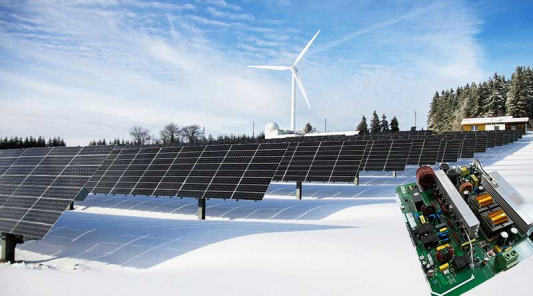
High-current PCBAs are vital to carry the big currents and spread heat well. In the circuit boards that handle voltage step up or down, if the PCB trace thickness cannot be made very thick, other ways, such as attaching copper busbars and nickel sheets with solder, are used to carry high currents and release heat. Below, high-current PCBAs made by PCBA Store for BMS, solar inverters, and charge controllers are shown. These cases prove how modern making helps solar energy product growth.
Basics of a Solar Energy System
A modern solar energy system changes sunlight into useful electricity through a matched set of tools.
The main parts include:
· Solar panels – convert sunlight into DC electricity.
· Charge controller – regulates voltage and current from the panels to safely charge the battery pack, often incorporating MPPT (Maximum Power Point Tracking) technology.
· Battery pack – stores DC energy, typically using lithium-ion cells.
· Battery Management System (BMS) – monitors cell voltage, temperature, and state of charge while protecting against overcharge, over-discharge, and thermal runaway.
· Solar inverter – converts stored DC power into AC power suitable for household appliances or grid feed-in.
· Energy Management System (EMS) – oversees overall power flow and optimization.
High currents appear during voltage step-up or step-down steps, DC-AC change, and quick charging/discharging. These states create much heat, so good current-carrying ability and heat control are key for every PCBA in the system.
High-current PCBAs for Charge Controller, Inverter, and BMS
High-Current PCBA for Charge Controller
Charge controllers handle huge power flows, especially in systems above 100 kVA. Combined busbar PCBAs split high-current paths from signal traces. Thick copper busbars (often placed in or soldered) take the main current load, while 3–6 oz copper traces on FR4 manage control signals. This plan boosts safety, cuts resistance, and improves heat spread. For systems over 250 kVA, combined busbar answers greatly raise efficiency and trust.
High-Current PCBA for Solar Inverter
Solar inverters do DC-AC change and voltage step-up, with efficiency drops of 2–5 % showing as heat. Big heat sinks and through-hole (PTH) part mounting increase heat move from power parts to the board and outside cooling. Wave soldering gives full tin cover in PTH holes, and exact heat control during soldering stops flaws in high-current spots.
High-Current PCBA for BMS
BMS boards need strong current sharing and great heat transfer. Several copper busbars soldered to the PCB spread current evenly, while terminal blocks give safe high-current links. Copper busbars provide better heat transfer than aluminum, allowing small designs that keep low running heat even under heavy load.
Cell Contact System (CCS)
The CCS in battery packs acts as a high-current link between cells and the BMS. It mixes flexible printed circuit assemblies (FPCA), thick copper busbars, and insulation layers. Large currents move through the main positive and negative busbars, making the CCS a special high-current PCBA. Solar energy CCS needs sit between those of energy storage and electric vehicle uses, requiring steady high-current carry and heat performance.
Electronic Components Used in the PCBAs of Solar Energy Devices
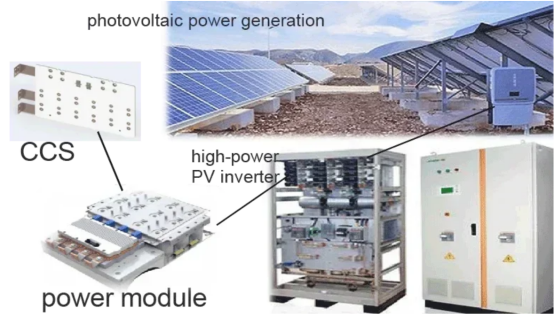
The tools in a solar energy system must stand high current and control current change or handle the charging task. In a solar energy system, these parts are used on PCBAs: Microcontrollers (MCUs), sensors, MOSFETs, IGBTs, and diodes.
MCUs
An MCU is a programmable chip that runs control plans, handles talk rules, and checks system values. In a solar energy system, MCUs are used in the PCBAs of the charge controller, BMS, solar inverter, and EMS. MCUs are used in the MPPT controller board of the charge controller device to improve currents from the solar panels.
Besides, the charge controller uses MCUs to talk with the BMS to stop overcharging. In a solar inverter, the MCU is used to check the input and output voltage and current. In a BMS, there are several MCUs for checking and handling the cell states and talking with the charge controller. Like BMS, the EMS relies much on MCUs for checking and handling the power making, storage, and use of the whole solar energy system.
MOSFETs and IGBTs
MOSFET and IGBT are both solid-state chips for voltage control. IGBTs fit the carry and control of medium to very high currents. MOSFETs are for low to medium currents but fit high-speed switching and boost. In a solar energy system, MOSFETs and IGBTs are key parts used in the charge controller, BMS, solar inverter, and EMS. They switch fast to shape the DC input from the solar panels into AC output at the wanted voltage and frequency.
Sensors
Voltage sensors, current sensors, and temperature sensors are all used in solar energy devices, including the charge controller, solar panel, battery pack, inverter, BMS, and EMS. In a solar energy system, voltage sensors and current sensors check the input and output voltage and currents of each solar energy device to make sure they stay in the right range. Temperature sensors are used to stop the device itself from getting too hot.
Diodes
Various diodes are used in solar energy devices, including the solar panel, charge controller, inverter, and EMS. The PCBA of a solar panel uses blocking diodes to stop current from flowing back to the panel and bypassing diodes to let current skip shaded or broken cells to cut power loss. The charge controller also uses blocking diodes. The solar inverter PCBA uses rectifier diodes for AC-DC change and freewheeling diodes for the guard of switching parts MOSFETs. The EMS uses rectifier diodes and signal diodes.
Besides, the PCBA of the charge controller uses DC-DC converters to step up or down the voltage from the solar panels to charge the lithium battery cells at the normal voltage of 24V/36V/48V. It also uses MPPT controllers to find the maximum power point for power pull from the solar panels.
What's more, in a solar energy system, the solar inverter has to change the DC to AC and step up the AC voltage to 110V or 220V. Besides MOSFETs, IGBTs, and MCUs for DC-AC change, the inverter PCBA also uses a step-up transformer to raise the AC voltage to the needed grid voltage of 110V or 220V.
Frequently Asked Questions (FAQ)
What PCB materials are recommended for solar inverters and BMS?
Heavy copper PCBs up to 30 oz, aluminum-based PCBs, copper-core PCBs, and ceramic PCBs are commonly used to gain better heat transfer, high current ability, and mechanical strength in high-power solar uses.
How is quality ensured in high-current PCBA manufacturing?
Making follows IPC-A-610 Class 2/3 rules, with full testing including AOI, X-ray check, in-circuit testing (ICT), and function check. All steps are ISO 9001:2015 certified, and full material and step tracking is kept for 15 years.
Can custom busbar integration be done for solar BMS and CCS?
Yes, copper busbars and nickel sheets can be soldered or placed into PCBs to spread high currents evenly, lower resistance, and boost heat spread in BMS and cell contact system (CCS) designs.
What is the typical lead time for high-current PCBA prototypes?
PCB making prototypes can be done in as little as 24 hours, with assembly in 12 hours. Full prototype turnaround ranges from 1 to 5 days, while volume making usually takes 1 to 10 days based on complexity and parts.
Is component sourcing provided for solar energy PCBAs?
Yes, full turnkey services include getting of active and passive parts such as MOSFETs, IGBTs, microcontrollers, sensors, diodes, and DC-DC converters, with free passive parts available from stock for qualified projects.
PCBA Store - High-Current PCBA Manufacturer for Solar Energy Devices
As a leading manufacturer, supplier, and factory, PCBA Store offers complete answers for high-current PCBAs in solar energy systems. From PCB making with heavy copper up to 30oz to full PCBA assembly, part getting, and box-build services, everything is managed under one roof in our Shenzhen facility.
Ready to improve your solar inverter, BMS, or charge controller projects? Get an instant online quote today at https://www.pcbastore.com/online_quote.html. Upload your Gerber files and BOM for quick, correct pricing—no MOQ, no setup fees.
For custom R&D help or bulk orders, email svc@pcbastore.com or call +86-755-27348887. Gain from free function testing, samples, and engineering aid to make sure your renewable energy products work reliably. Contact PCBA Store now and power the future of solar energy with high-quality, low-cost PCBAs. Let's build lasting solutions together!
You Might Like:
What Are Rigid Flex Circuit Boards?
How to identify your electronics manufacturing service providers ?
The Methods of Avoiding Silkscreen Errors in PCB Manufacturing



