General, quoting & support.
Add: Building E, No.58, Nanchang Road, Xixiang , Baoan District Shenzhen City, Guangdong, China
Tel : 0755-27348887
Fax : 0755-27349876
E-mail : svc@pcbastore.com

High-Density SMT for Mini Drone PCB
PCBA Store / 2026-01-23
Contents [hide]
In the fast-growing world of unmanned aerial vehicles (UAVs), engineering problems have changed a lot. The market now wants drones that are smaller, lighter, and smarter. These drones need features like AI-based flight control, clear video, and strong data recording. This leads to a big challenge for engineers: fit advanced functions into a small PCB while keeping weight low and costs reasonable. This case study looks at how an embedded systems developer focused on IoT and electronics solved this issue. They built a smart flight controller on a small 10x250px PCB. The success came from high-density SMT assembly and good manufacturing partners. PCBA Store offered combined PCB making and assembly services to handle the main problems.
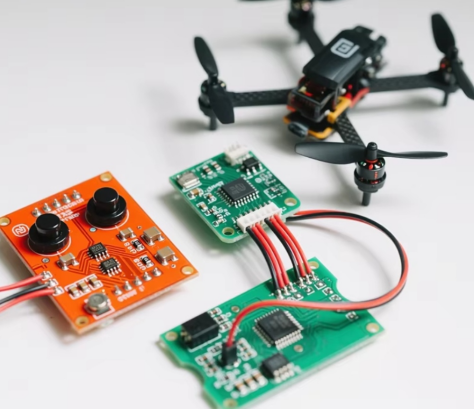
Project Overview: The Mini PCB Flight Controller
The project used one PCB as the complete brain and power setup for a small quadcopter. Component choices focused on high-performance, tiny SMD parts to pack as much function as possible into the limited space.
The main processor was the ESP32-S3 N16R2 module. It was picked for its dual-core speed, built-in 2.4 GHz Wi-Fi and Bluetooth 5 (LE), and direct USB OTG support. This made it great for processing, wireless links, and basic AI tasks at the edge.
For pictures, an OV2640 camera module linked through a 24-pin FPC connector gave cheap yet good-quality images. These were key for FPV flying and possible computer vision work.
Stability came from an MPU-6050 6-axis IMU. It provided important data on position and balance for smooth flight.
Data storage used a fast SD-MMC link via a TF-Push card slot. This allowed quick saving of flight logs and pictures. It was much better than slower SPI methods.
The Challenges: High-Density & High-Speed PCB
A 2-layer PCB was chosen to save money and reduce weight. However, it created big difficulties for high-speed and crowded designs. The project faced three key technical issues.
Challenge 1: Extreme Component Density & Double-Sided Surface Mount Technology (SMT)
The board reached a max size of 100x100mm. It had a complex drone-frame outline with cutouts for motors. This cut down usable space and made density even harder. To fit everything, double-sided assembly was needed. Components went on both top and bottom layers.
The top layer held main compute parts like the ESP32 and IMU. It also included the whole power management section with charging chips and regulators. The bottom layer took high-speed connectors for the camera and SD card.
This setup used over 70 SMD components from 31 different types. These included fine-pitch packages like QFN and SOT-23-6, plus many 0402 passives. Professional automated SMT assembly was essential for accurate placement and solid soldering.
Challenge 2: High-Speed Signal Routing on 2-Layer PCB
Routing fast interfaces was the toughest problem. The SD-MMC (4-bit) and OV2640 camera (8-bit parallel DVP) worked as parallel buses. Their clocks were very sensitive to trace length differences and noise.
On a 2-layer board, these traces ran close together. They were also near high-current motor paths and switching power lines. This raised chances of crosstalk and noise that could ruin data, add camera problems, or break SD card work.
Challenge 3: Power Distribution
The PCB also acted as a power distribution board. It handled power from a LiPo battery through protection circuits, charging, and three separate low-noise regulators. Quick high-current bursts from motor-control MOSFETs to coreless motors could add noise to sensitive analog lines for the camera and MCU. This might lead to unstable operation.
The Solution: Integrated PCB Assembly & In-Stock Parts Ecosystem
To cut manufacturing risks, the project used a single service for fabrication and assembly. Advanced PCB assembly services managed reliable double-sided SMT for fine-pitch parts on an odd-shaped board.
A large in-stock parts library let the design focus only on checked, ready SMD components. All 31 types—from the ESP32-S3 module to 0402 passives—came from one central stock. This ensured BOM fit, steady supply, and easier assembly steps.
From DFM to PCBA: A Technical Deep-Dive into the SMT Assembly Process
1. Design for Manufacturability (DFM) with the Parts Library
The process put DFM first from the beginning. Component picks happened during schematic work. Every SMD part came from the in-stock list. Its exact part number and footprint went in early.
This made full BOM and CPL match before routing started. It avoided common problems like missing parts or assembly mismatches. It also sped up the move to production.
2. Board Specifications & High-Speed PCB Layout
The final 2-layer FR-4 board was 100x100mm with ENIG surface finish. This gave a flat surface needed for fine-pitch SMD soldering. ENIG reduced solder bridging risks. It supported strong joints on QFN and similar packages during reflow. It worked better than HASL for precise jobs.
High-speed routing depended on tight manufacturing controls to handle parallel bus signals well on few layers.
3. Key Components Sourced & Assembled
The complete SMT BOM covered many groups: the ESP32-S3 in QFN, MPU-6050 in QFN-24, power management ICs like TP4056 and DW01A in SOP-8 and SOT-23-6, voltage regulators in SOT packages, motor control MOSFETs, various connectors, and a mix of 0402/0603/0805 passives plus switches, LEDs, and buzzers.
4. Automated Assembly of Fine-Pitch & SOT Components
With over 70 placements including fine-pitch QFNs, SOT ICs, and small 0402 passives, hand assembly was not possible. Double-sided SMT needed two full cycles: solder paste deposit, pick-and-place, and reflow for each side. This required careful heat control to avoid affecting parts already soldered.
Automated high-speed SMT lines gave precise work on both sides. Only a few through-hole headers needed hand finishing.
Results & Outcome: A Fully Operational Flight Controller
Five fully assembled double-sided boards came in just 7 days. Early tests showed perfect cutting of the odd shape, good double-sided alignment, steady power lines, successful ESP32 startup, IMU recognition, and clean high-speed links: the SD-MMC worked at full speed for logging, and the OV2640 gave clear video without issues.
This removed hardware fixes from assembly problems. It let the team jump straight to firmware work.
Customer Feedback
The engineer pointed out the value of quick delivery for complex double-sided PCBA. They noted perfect quality with no solder bridges or flaws despite fine-pitch parts and unusual board shape. High-speed lines working on the first try showed good manufacturing accuracy. Unified parts sourcing saved a lot of time and cut supply risks.
Key Takeaways
This project shows how combined services help with tough high-density designs on cheap 2-layer PCBs. Precise SMT assembly for double-sided boards, plus a big in-stock parts supply, takes away sourcing and manufacturing blocks. Engineers can then focus on new ideas and software.
PCBA Store provides these features as professional PCB fabrication and assembly factory. It offers scalable, high-quality options for hard projects like this mini drone flight controller.
Partner with a Reliable PCBA Manufacturer
For businesses looking for trustworthy PCB fabrication and full PCBA services, PCBA Store stands as a leading manufacturer, supplier, and factory offering end-to-end solutions. With in-house production, a vast in-stock components library exceeding 610,000 parts, advanced double-sided SMT capabilities for fine-pitch and high-density designs, and rapid turnaround times as fast as one week, PCBA Store streamlines prototyping to production. Companies can achieve consistent quality, reduced lead times, and cost efficiency by leveraging this integrated ecosystem for complex assemblies. Contact the team today to discuss project requirements, request quotes for custom PCB and PCBA needs, or explore how in-stock parts and automated assembly can accelerate development cycles.
FAQs
Q1: Why was ENIG surface finish selected for this high-density SMT project?
ENIG delivers a flat, uniform surface ideal for fine-pitch QFN and 0402 components. It minimizes solder bridging risks and ensures reliable reflow joints compared to HASL, which can produce uneven topography.
Q2: What does a DFM-first workflow involve in practice?
The approach begins with the parts library rather than the schematic alone. All components are selected from confirmed in-stock options with verified footprints and part numbers integrated early, guaranteeing assembly compatibility throughout design.
Q3: Why does double-sided SMT assembly present challenges?
It requires two complete cycles of solder paste application, pick-and-place, and reflow—one per side. The second reflow exposes first-side components to additional heat, necessitating precise profile control, orientation planning, and thermal management to prevent shifting, re-melting, or damage.
Q4: Can complex non-rectangular board shapes be handled in fabrication and assembly?
Yes, precise milling achieves exact contours like drone frames, while SMT lines accommodate and align irregular boards accurately for single- or double-sided placement.
You Might Like:
Your Ultimate Guide to Choosing the Best Drone PCB
Double Sided PCB Assembly and Soldering: A Comprehensive Guide



