General, quoting & support.
Add: Building E, No.58, Nanchang Road, Xixiang , Baoan District Shenzhen City, Guangdong, China
Tel : 0755-27348887
Fax : 0755-27349876
E-mail : svc@pcbastore.com

High Frequency PCBs - PCB Prototype the Easy Way
PCBA Store / 2025-12-09
Contents [hide]
What is High Frequency (HF) PCB?
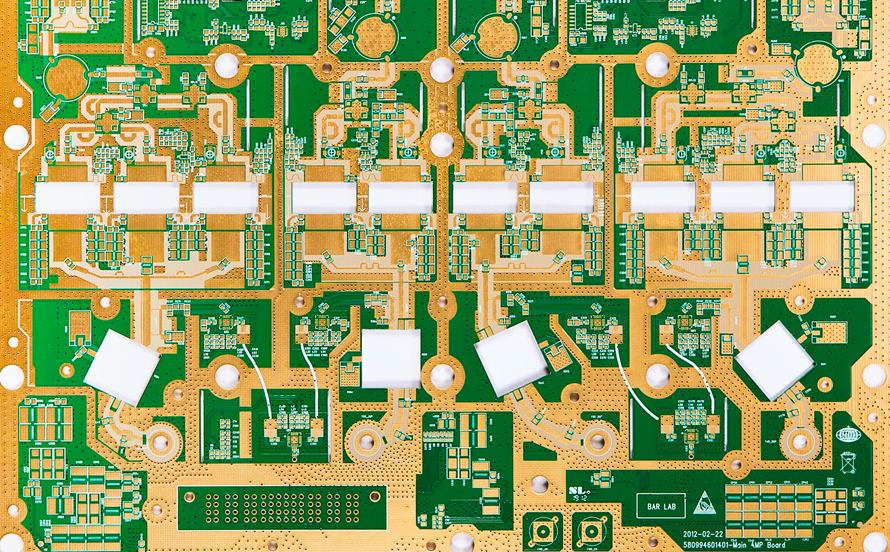
In the electronics world, people usually call a PCB "high-frequency" when it works above 1 GHz. These special boards need very strict control over materials, accuracy, and technical details.
You often find them in radar systems, military equipment, aerospace parts, and telecom devices. When designers create these boards, they must check many important factors carefully. This helps keep signals clean and strong in fast, high-frequency settings.
The most important factors are dielectric constant (Dk), dissipation factor (Df), coefficient of thermal expansion (CTE), and thermal conductivity. All of them greatly affect how well the whole board works.
img.What is High Frequency (HF) PCB.jpg
Characteristics of High-frequency PCB
High-frequency PCBs use special materials and build methods. These help them carry signals perfectly even at very high speeds. The boards lose almost no signal strength. That makes them perfect for critical jobs like aircraft systems and RF transceivers.
Low Dielectric Constant (Dk)
A low Dk value slows down signals less. It lets data move quickly across the board. Most designers choose materials with Dk under 3.5. Higher Dk creates extra capacitance. That capacitance makes signals travel slower. This feature matters a lot in fast systems such as millimeter-wave radar units. Even tiny delays of a few picoseconds can break timing.
Low Loss Factor (Df)
The loss factor (Df) shows how much energy disappears while the signal travels. Smaller numbers mean clearer signals. Engineers aim for Df below 0.005 at 10 GHz. This keeps signals strong and clean. Less loss gives better reception in wireless base stations. Extra noise from the material could ruin the signal quality there.
Coefficient of Thermal Expansion (CTE)
The substrate and copper should expand at nearly the same rate when temperature changes. A difference under 15-20 ppm/°C works best. This match stops layers from peeling apart during hot and cold cycles. It is very important for aerospace boards that face big temperature swings. The board stays strong mechanically and keeps good electrical connections.
Low Water Absorption
Good materials absorb less than 0.1% water. They keep Dk and Df steady even in wet conditions. If moisture gets inside, loss increases and performance becomes unstable. This problem often hurts outdoor telecom gear.
Additional Essential Properties
These boards handle soldering heat up to 260°C easily. They resist chemicals well, so etching liquids do not damage them. They are also tough against drops and have strong copper peel strength (>1 N/mm). All this makes them survive automatic assembly machines and years of real-world use.
Together, these features make high-frequency PCBs much better than regular FR-4 boards when signal loss must stay tiny. Newer materials like hydrocarbon-ceramic mixes show how far material science has come for GHz-level work.
High-frequency PCB Design Considerations
img.high-frequency PCBs assembly top China factory online quote.jpg
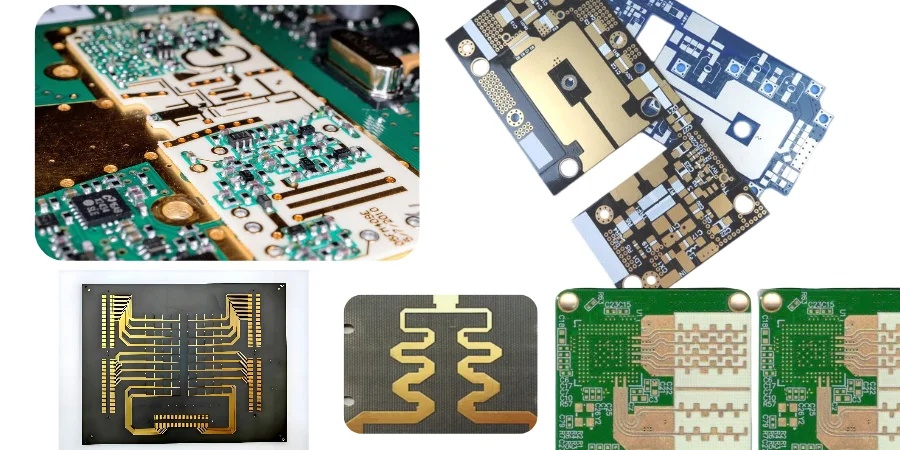
Creating high-frequency PCBs requires extreme care with trace paths, impedance values, and noise control. Designers follow strict rules so signals stay clean even when they switch millions of times per second. These rules form the base for boards used in fast RF and microwave systems.
Routing Method
Sharp 90-degree corners cause reflections and extra noise. Instead, use smooth 45-degree bends or curved arcs. These gentle shapes keep impedance steady. They stop signals from bouncing back or leaking to nearby layers. This mistake often appears in crowded radar boards.
Routing Length
Keep important traces short, usually under 10 cm for clock lines. Long traces act like antennas and create unwanted radiation. They also pick up noise from nearby lines. Standards like DDR4, USB 3.0, and 10G Ethernet need short paths to keep the signal shape perfect.
Number of Vias
Use as few vias as possible. Each via adds about 0.5 pF extra capacitance. That slows down fast edges and can create data mistakes. Blind or buried vias help when you must change layers. They keep signals flowing smoothly in multi-layer boards such as phased-array antennas.
Avoiding Crosstalk
Crosstalk happens when two traces run parallel and close together. Energy jumps from one to the other and creates noise. You reduce it by smart layer arrangement, correct driver strength, and proper ending resistors. Solid ground planes under signal lines block far-away coupling. Running traces at right angles on neighboring layers cuts coupling by up to 80%.
Add High-frequency Decoupling Capacitors to the Power Supply Pins of Integrated Circuit Chips
Place small 0.1 µF ceramic capacitors no farther than 5 mm from IC power pins. They remove high-frequency noise from the power lines. This keeps voltage steady inside FPGA-based RF systems and stops random logic errors.
Isolate the Ground of High-frequency Digital Signals and the Ground of Analog Signals
Keep digital and analog grounds separate. Use ferrite beads or connect them only at one point. Digital noise is full of sharp spikes. Those spikes ruin sensitive analog measurements. RF chokes (>1 kΩ at 1 GHz) give clean separation in mixed-signal ADCs.
Avoid the Formation of Loops Resulting from Routing
Big loops in return paths work like small antennas. They radiate noise at odd harmonics. Differential pairs or guarded returns keep the loops tiny. This improves immunity in car radar modules.
Adopt Fly-by Topology/Daisy Chain Routing For DDR4
Fly-by routing spreads clock connections evenly. It reduces reflections on memory buses. This method keeps timing skew under 50 ps. It works great for 3200 MT/s DDR4 in large servers.
Adopt the 20H Rule to Minimize Plane Coupling
Pull power planes inward by 20 times the dielectric thickness from the edge. This stops unwanted waves along the edges. At 20H distance, about 70% of the magnetic field stays inside. It reduces RF leaks in powerful amplifiers.
Necessary to Ensure Proper Signal Impedance Matching
Keep characteristic impedance near 50 Ω all the way. Use exact trace width and material thickness. Sudden changes cause overshoot and ringing. Smooth width changes and rounded corners remove ghost signals in gigabit systems.
When engineers use tools like HFSS to test these ideas, the final boards handle high-frequency problems such as dispersion and mode changes without trouble.
Common Materials for HF PCB
Most high-frequency boards today use hydrocarbon/ceramic laminates. They give very low loss and are easy to manufacture. The Rogers RO4000 series leads the market. It works perfectly from microwave up to mmWave frequencies and keeps Dk steady.
Rogers RO4003C is a reinforced hydrocarbon/ceramic composite. It has Dk=3.38 and Df=0.0027 at 10 GHz. This makes it excellent for wide-band antennas. Its Tg>280°C and Td=425°C handle reflow soldering easily. Z-axis CTE=46 ppm/°C matches copper very well.
Rogers RO4350B is similar. It offers Dk=3.48 and Df=0.0037 with Tg>280°C. Peel strength reaches 0.88 N/mm. Both materials absorb almost no water (<0.1%) and conduct heat at ≈0.7 W/m·K. That prevents hot spots in power RF boards.
These Rogers materials are much easier to process than PTFE and give steady results every batch. Other good choices include Taconic TLY-5 for extremely low-loss needs.
What is a Rogers PCB?
Rogers PCBs are built with special laminates made by Rogers Corporation. They combine unique dielectrics with copper layers. The result is outstanding low-loss performance for RF and microwave uses. You see them a lot in 5G base stations and phased-array systems.
Short videos show how the layers are pressed together. The finished boards stay flat and perform the same everywhere. Rogers materials fight skin-effect loss even above 110 GHz.
High Frequency (HF) PCB vs. High-Speed PCB
High-frequency PCBs focus on radio and microwave signals (300 MHz to over 10 GHz). They need very low Dk and Df to keep signals strong over distance. High-speed PCBs handle fast digital data (up to 25 Gbps or more). They care more about exact timing and low crosstalk in servers and telecom gear.
Both types work in the GHz range sometimes. Still, HF boards care most about pure dielectric quality. High-speed boards focus on timing control. Choose HF for analog RF work and high-speed for serialized digital streams.
FAQ
Q: What frequency range defines a high-frequency PCB?
A: Generally, frequencies above 1 GHz qualify as high-frequency, though applications may extend to mmWave bands exceeding 30 GHz.
Q: Why is low dielectric constant important in HF PCBs?
A: It reduces signal delay, enabling faster propagation essential for time-sensitive RF systems.
Q: What materials are commonly used for high-frequency PCBs?
A: Rogers RO4003C and RO4350B are prevalent, offering low loss and thermal stability.
Q: How does crosstalk impact high-frequency designs?
A: It introduces noise via electromagnetic coupling, degradable signal-to-noise ratios in parallel traces.
Q: What is the 20H rule in PCB design?
A: It prescribes inset power planes by 20 times dielectric thickness to suppress edge radiation.
Partner with a Leading PCB Manufacturer and Supplier for High-Frequency Solutions: PCBA Store
Companies that need large or small runs of high-frequency PCBs gain a lot by working with experienced factories. PCBA Store acts as a top-tier PCB manufacturer, supplier, and factory. The company provides accurate boards made with genuine Rogers materials such as RO4350B and RO3003. Minimum track and spacing reach 2 mil with impedance control within ±8%.
Customers get instant online quotes, no MOQ (starting at only 10 pieces), and 24-hour express service. This speeds up everything from prototypes to full production (SMT/THT mixed, up to 64 layers). With IPC Class 3 and ISO 9001 certifications, PCBA Store ships 99% of orders on time via DHL. Full-turnkey PCBA includes AOI and X-ray inspection. Send Gerbers to svc@pcbastore.com today and receive competitive B2B prices for RF projects.
You Might Like:
How PCB Assembly Services Accelerate Your Product's Market Launch
The Right Mix of PCBA and Customer Service
Exploring Methods for Rapid PCB Prototyping
Fast and Efficient PCB Assembly Services for High-Volume Manufacturing



